
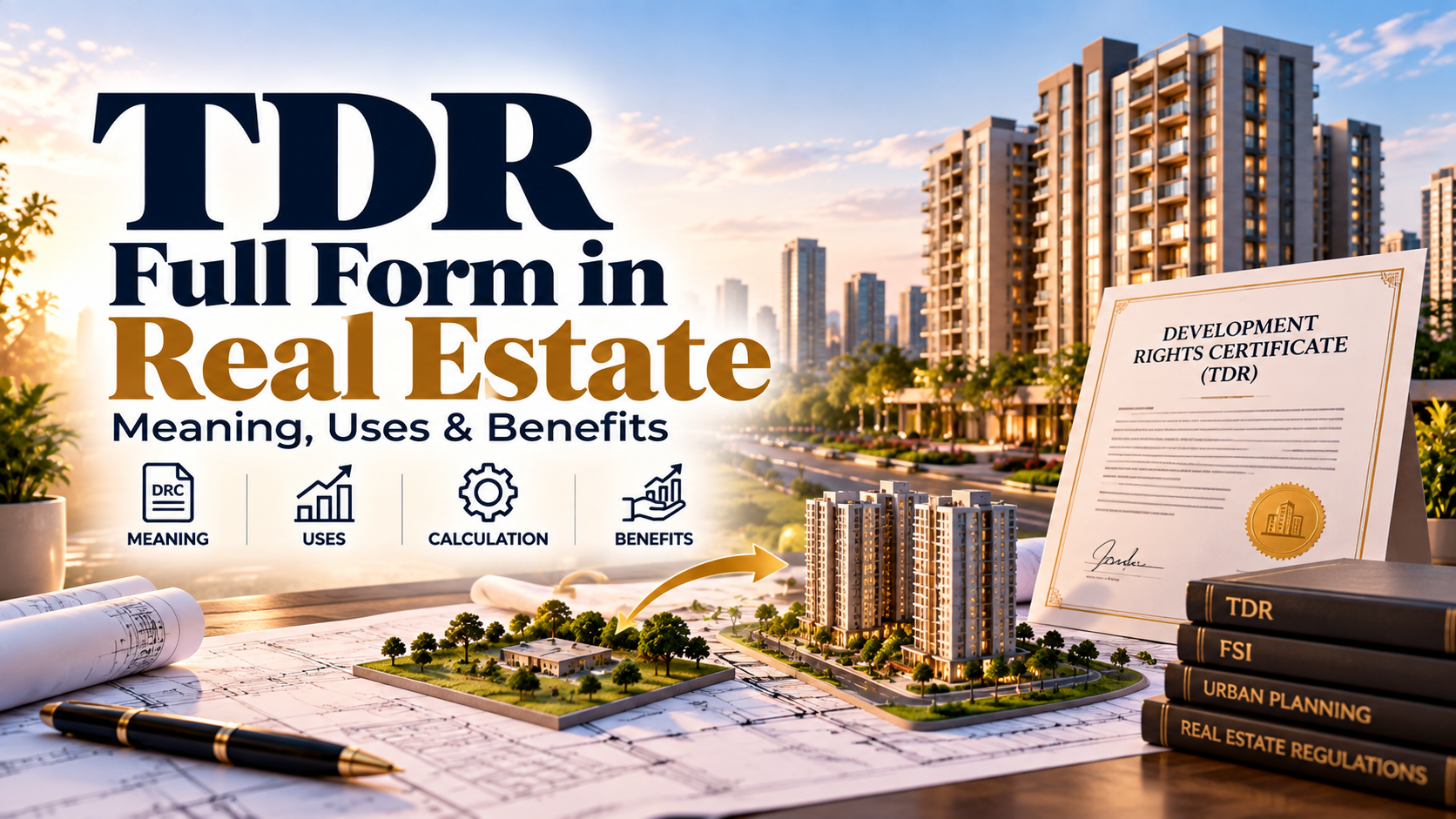
The process of buying a property is an elaborate one that comes with the responsibility of understanding a lot of real estate terms. Once such term is TDR. TDR full form in real estate is Transferable Development Rights. TDR lets a person transfer the development rights of a land to another property. Simply put it allows the development rights of one property to be used somewhere else.
TDR is mainly used when land is needed for roads, public facilities, open spaces, or other development work. In such cases, the landowners may get development rights that can be transferred or used as per the local rules. The process and rules can be different from one place to another.
TDR can be useful for both landowners and developers. So, it is important to understand how it works, where it can be used, and what rules apply. In this blog, we will explain the TDR full form in real estate, its meaning, uses, benefits, calculation, and other important points.
What Is the TDR Full Form in Real Estate?
TDR full form in real estate is Transferable Development Rights. This system is used in city planning where the right to develop a piece of land can be transferred to another property, as per the local government rules. TDR is useful when the government needs to keep land for public or other important purposes.
This includes land needed for roads, parks, schools, playgrounds, open spaces and other areas. Instead of using that land for construction, the owner may get development rights as compensation, depending on the applicable rules.
These development rights can then be transferred or sold to another eligible property or developer. The developer can use the rights to get additional development potential, such as building more area than normally allowed under the applicable FSI rules. Knowing the TDR meaning in real estate is important for both buyers and developers.
In simple words, TDR helps balance land protection and city development. It allows important land to be used for public needs while giving eligible landowners a way to receive value through development rights.
How Does TDR Work in Real Estate?
The Transferable Development Rights process involves transferring development rights from one piece of land to another subject to local authority rules, but the concept is simple.
1. Land is identified
First, the land is identified as being available for a public use (road, park, school, or other work) and is identified for development, under the conditions of the rules.
2. Development Rights Are Given As Compensation
A landowner who meets the criteria may be entitled to development rights. These rights can be granted via a TDR certificate or other process, depending on the local authority.
3. Rights Are Transferred
The development rights can be transferred or sold to another eligible person or developer under the conditions outlined by the authority in question.
4. Developer Uses the Rights
The developer who receives the Transferable Development Rights can use the additional development rights on an eligible property to allow additional construction above the normal limit based on the applicable FSI, FAR, and local development rules.
Benefits of TDR in Real Estate
TDR in real estate benefits both the landowners and the developers. It also helps the local authorities manage how land is used in growing cities. Here are some benefits of TDR:
1. Better Use of Land
Transferable Development Rights allows development rights to be moved from one property to another, as allowed by local rules. This helps make better use of land in areas where more development is allowed, while protecting land that may be needed for public or other important purposes.
2. Supports Public Development
TDR can help authorities get land for roads, parks, schools, playgrounds and other public projects. This can support the development of better facilities in growing areas without following the usual land purchase process in every case.
3. Helps Developers Build More
In some cases, developers can use TDR in real estate to get additional development potential for their projects. This may allow them to build more area than the normal limit, subject to the FSI, FAR and other rules of the concerned authority.
4. Protects Important Land
TDR can help protect land that has environmental, heritage or other public value. Instead of allowing more construction on such land, development rights may be transferred elsewhere as per the applicable rules.
5. Supports Planned City Growth
TDR in real estate helps guide development towards areas where additional construction can be supported. This can help authorities manage the growth of cities in a more planned way while also protecting certain areas from unwanted development.
Types of Transferable Development Rights (TDR)
There are different types of TDR in real estate. The type usually depends on why the land is being given for public use. The rules can also be different depending on the state and local authority.
1. Road TDR
Road TDR is given when private land is used for road widening, new roads, or other road work. The landowner may get development rights in return, as per the rules.
2. Reserved Plots TDR
This TDR is related to land that is kept for public use. It can include land needed for parks, schools, playgrounds, or other public facilities.
3. Slum TDR
Slum Transferable Development Rights is used in slum rehabilitation projects. Developers may get development rights when they provide housing or rehabilitation to eligible slum residents.
4. Heritage TDR
Heritage TDR may be given to owners of heritage properties where construction or redevelopment is restricted. It helps provide value for the development rights that cannot be used on that property.
5. Accommodation Reservation TDR
This type of TDR is used when land is reserved for a specific public purpose. The owner may get development rights or some built-up area benefit in return, depending on the local rules.
How is TDR Calculated in Real Estate
TDR is calculated based on the land area given up and the rules of the local authority. The TDR calculation can be different in every city.
TDR Calculation Formula:
TDR = Land Area Surrendered × Permissible Development Factor
For example, if a landowner gives up 1,000 sq. ft. of land and the applicable development factor is 2, the TDR would be:
TDR = 1,000 × 2 = 2,000 sq. ft.
The development factor depends on things like location, FSI, zoning rules, road width and the purpose for which the land is being used. So, there is no single TDR calculation that applies everywhere.
The final Transferable Development Rights is decided by the concerned development authority as per the local rules.
Factors that Affect the TDR Calculation in Real Estate
TDR calculation is not the same everywhere. Different cities and states can have different rules for calculating it. Several things are considered before deciding the amount of TDR a landowner can get.
1. Location
The location of the land affects the calculation of TDR. Areas that come with restrictions like heritage sites or environment sensitive areas have different rules. The development potential of the area is also considered by the concerned authority.
2. Plot Size and Zoning
The size of the plot or land and its zoning also affects TDR. The rules for residential, commercial and other zones are different. The permitted development of a zone is also taken into consideration during TDR calculation.
3. FSI Rules
FSI is an important factor in TDR calculation. It decides how much construction is normally allowed on a plot. The applicable FSI can affect how much additional development can be received through TDR.
4. State and Local Rules
Transferable Development Rights rules are different for different cities and states. The local development authority decides the calculation method, eligibility, limits and other conditions that need to be followed.
5. Purpose of Land
The reason for giving up the land can also matter. Land used for roads, parks, schools or other public purposes may have different TDR rules depending on the local development plan.
Summing Up
Knowing the TDR full form in real estate can be very helpful whether you are buying land or developing a property, or working on a construction project. TDR means Transferable Development Rights. Development rights can be used or transferred from one property to another as required by local rules.
The Transferable Development Rights can be a very valuable tool for landowners as well as developers. But, the rules may differ in every city or state, including the methods and types of calculations, the transfer and its use. Before you buy or use TDR you must check the rules of the local authority and the details of the TDR certificate.
FAQs
How is TDR calculated?
TDR stands for Transferable Development Rights. You can calculate the TDR by multiplying the area of the land surrendered for public use by the permitted FSI or FAR of that zone.
How does TDR work in real estate?
TDR allows the right to build on one piece of land to be transferred and used on another property.
What does TDR stand for in real estate?
TDR full form in real estate is Transferable Development Rights.
What is TDR and FSI in real estate?
FSI and TDR are planning tools used by local authorities to manage building sizes and city development.
Prestige Towers is one of the best 3 bhk residential projects in Mohali.
